Myanmar continues to rank among the top suppliers of rare earths to China, accounting for more than half of China’s rare earth imports from abroad. In the first nine months of this year (up to September 2025), Myanmar’s rare earth exports to China were valued at USD 624 million. However, this marks a decline compared with the same period last year.
The discrepancy in reported trade values between Myanmar and China has exceeded USD 63 billion over the past eight fiscal years, with over USD 45 billion emerging after the 2021 military coup. This widening gap is likely driven by post-coup factors, such as surging rare earth exports to China, expanding territorial control by armed groups along the border, and the growth of the illicit economy.
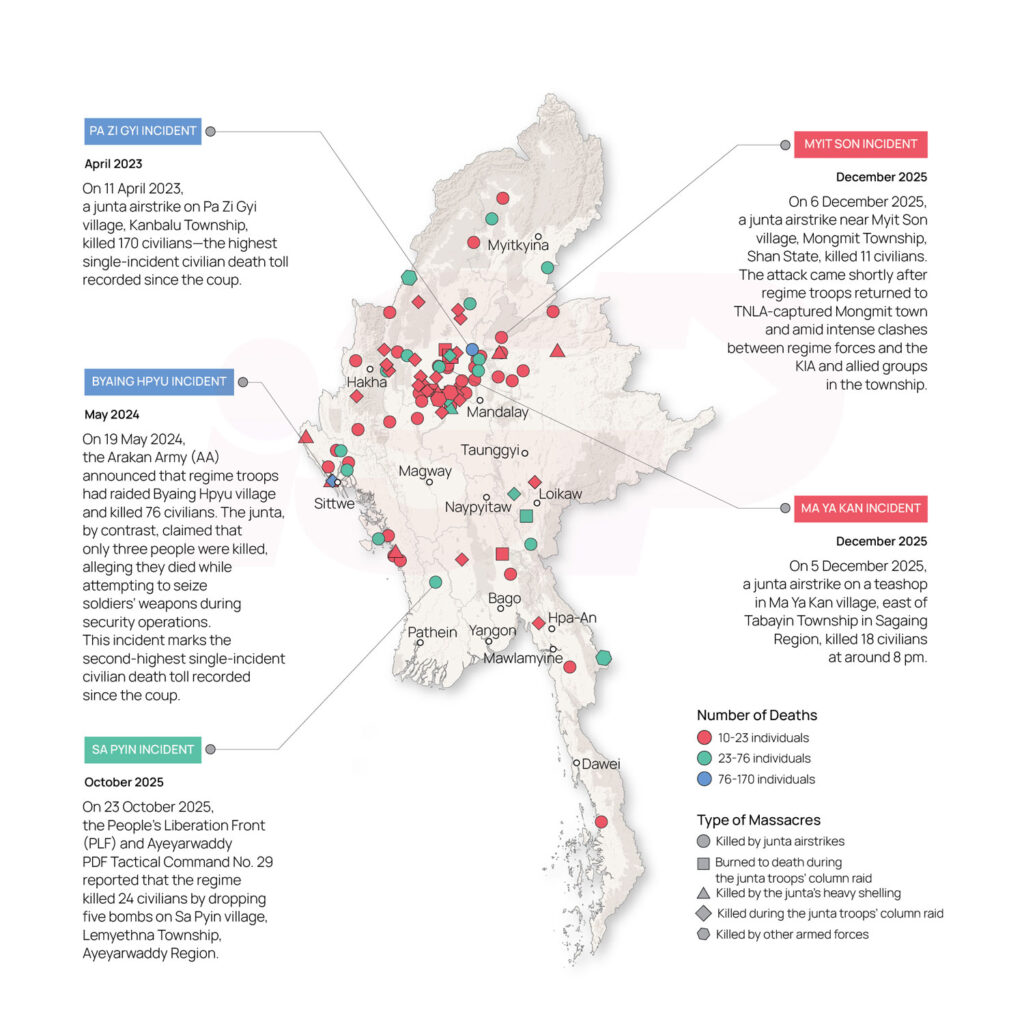
According to recent research, fighting has fallen by roughly one-third compared with last year. Airstrikes and civilian casualties have also declined. However, the number of internally displaced persons (IDPs) continues to rise: this year alone, nearly 700,000 additional people have been forced from their homes. It remains unclear whether violence will keep decreasing under Chinese mediation or whether military intensity will escalate again around the election.
The junta regime is intensifying its counter-offensives in northern Shan State to regain territory lost during Operation 1027. The regime has recaptured Nawnghkio, Kyaukme, and Hsipaw from the TNLA, and—with China’s support—has also retaken Lashio. The gains are limited, but the towns regained are key urban hubs for Myanmar–China border trade.