


Photo – AFP
This Conflict Security Tracker No. 2 English Version was published on December 11, 2025, as a translation of the original Burmese version published on December 10, 2025. Figures reflect data available up to December 9, 2025.
A recent major incident, the airstrike on Mrauk-U General Hospital in Rakhine State at 9:13 pm on December 10, which killed more than 33 civilians, falls outside this reporting period and is not included. If counted, the total would rise to 96 incidents and more than 1,894 deaths.
▪️Period
February 1, 2021, to December 9, 2025
▪️Incidents/events
During nearly five years, at least 95 incidents of mass civilian killings—defined as single events in which 10 or more people were killed—have claimed at least 1,861 lives. This toll includes two recent attacks: one in Ma Ya Kan village, Tabayin Township, Sagaing Region, on December 5, and another in Myit Son village, Mongmit Township, Shan State, on December 6.
▪️Locations
Massacres have occurred across the country, except for the Yangon Region. Sagaing Region recorded the highest number of incidents, at 41.
▪️Actors involved
Myanmar junta forces and armed resistance forces.
▪️Types
Mass civilian deaths caused by armed assaults, arson, and airstrikes.
▪️Status/trends
Of total incidents, 91 were perpetrated by the regime’s troops, resulting in 1,776 civilian deaths. Resistance forces were responsible for the other four incidents, which resulted in 85 civilian fatalities. Airstrikes were the most common method, accounting for 59 percent of deaths. These mass casualty events may continue as the junta intensifies ground offensives and intensifies its use of fighter jets, combat helicopters, and drones.
▪️Risk Level
Civilians residing in resistance-controlled or contested territories face the greatest risk. The junta’s strikes targeted civilian properties, religious sites, hospitals, and schools. Consequently, these conditions indicate that the levels of civilian protection during conflict are extremely challenging.
▪️Implications
Placing military victory above all else—and operating as pre-emptive strikes with indiscriminate attacks—carries serious consequences. By prioritizing battlefield gains alone, the perpetrators risk further entrenching their record of war crimes, likely driving up civilian casualties and cases of domicide.
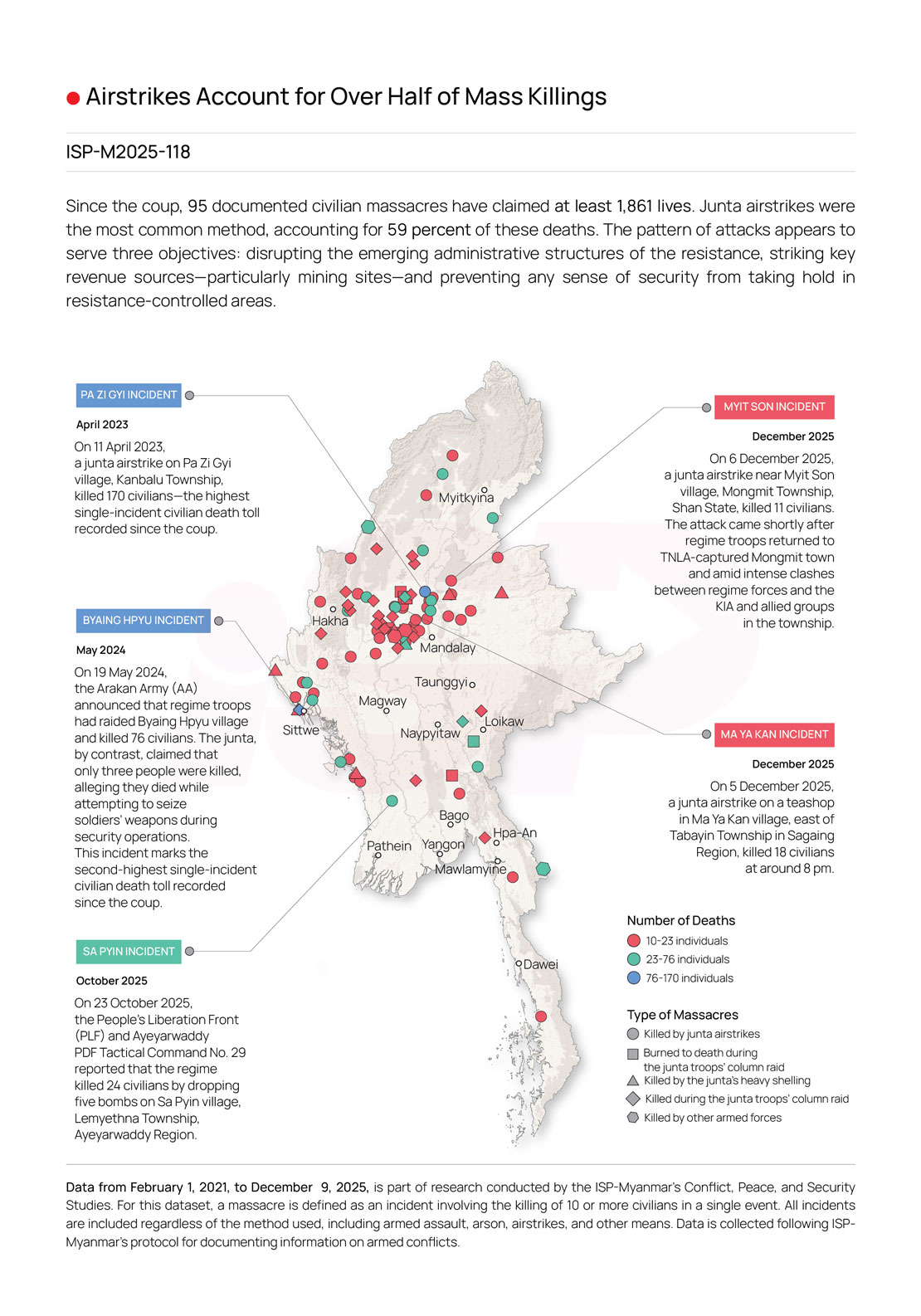

ISP Conflict & Security Tracker
95 Civilian Massacres Recorded Since the Coup