
Photo – AFP
This Stakeholder Tracker No. 5 (English Version) was published on December 18, 2025, as a translation of the original Burmese version published on December 17, 2025.
▪️Period
February 1, 2021 – December 15, 2025
▪️Stakeholders
Regional military commanders of the Myanmar Armed Forces
▪️Issues/activity
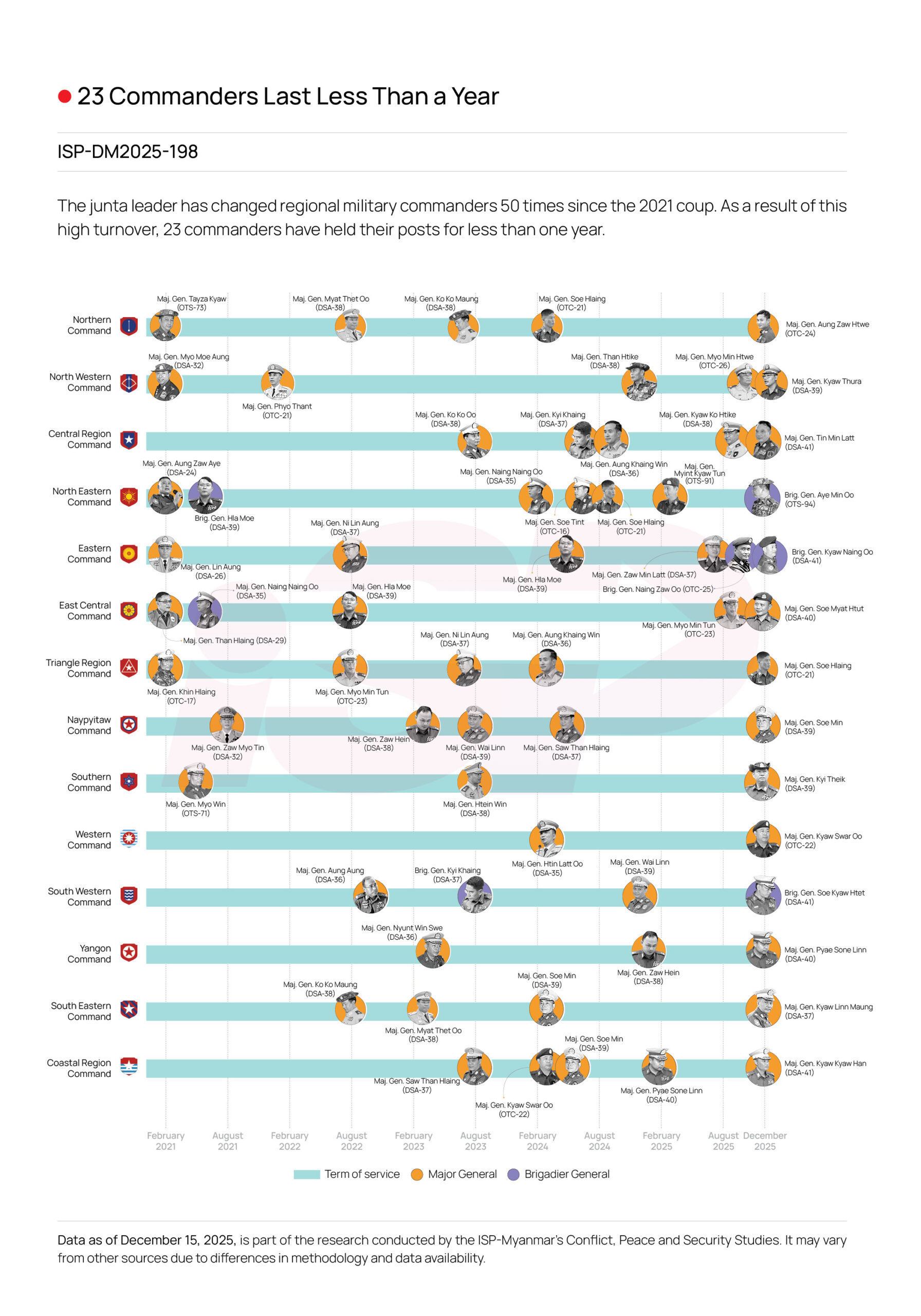
In the nearly five years since the 2021 coup, the junta leader has reshuffled commanders across Myanmar’s 14 Regional Military Commands (RMCs) a total of 50 times. In all, 46 officers—40 major generals and six brigadier generals—have been reassigned or removed, with several experiencing multiple postings.
▪️Status/trends
The junta has increased the frequency of leadership changes across the 14 Regional Military Commands (RMCs), whose commanders oversee frontline military operations. While some changes followed battlefield setbacks, others occurred in commands that experienced relatively low levels of active fighting. Turnover has been most pronounced in the North Eastern Command, followed by the Eastern Command, Naypyitaw Command, and East Central Command. By contrast, the Western Command in Rakhine State has only had two commanders, reflecting a single change. Before the coup, a regional military commander typically served two to three years in a single post. Since then, tenure has shortened markedly: 23 commanders have held their positions for less than one year.
▪️Implications
Each change of RMC leadership brings a shift in how military strategy is implemented in that area. The fact that commanders are being rotated even in relatively quiet commands suggests that reshuffles are not driven solely by operational needs. They can also be read as part of the junta leader’s efforts to consolidate personal control over the armed forces. As tenures shorten, regional military commanders have less time to build relationships with subordinate battalions and divisions, limiting their ability to develop personal influence and independent power bases.
▪️Relevance
Tracking changes in regional military command provides insight into how the junta leadership manages its internal power structure. When considered alongside assessments of “fourth-generation Tatmadaw” figures—outlined in ISP-Myanmar’s OnPoint No. 27—these insights could help develop strategies that could shape the power shifts in Naypyitaw in the post-election period.

ISP Stakeholder Tracker
Junta Leaders’ Constant Shake-Up